





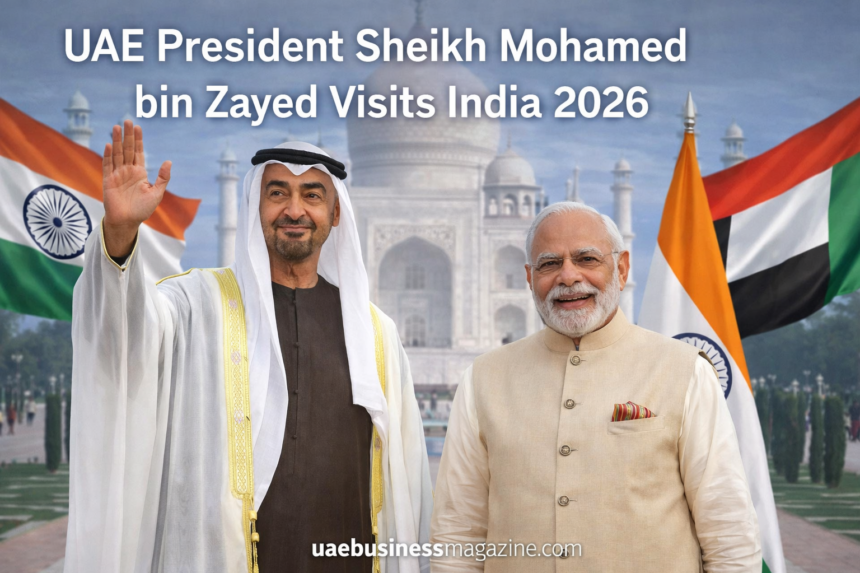
His Highness Sheikh Mohamed bin Zayed Al Nahyan, President of the United Arab Emirates, arrived in New Delhi, India on Monday, January 19, 2026, for a high-level business and strategic visit. Indian Prime Minister Narendra Modi personally welcomed the UAE leader, signaling the importance of UAE-India relations.
UAE President Sheikh Mohamed bin Zayed Arrives in New Delhi
President Sheikh Mohamed bin Zayed Al Nahyan landed at Palam Air Base in New Delhi on Monday, January 19, 2026, marking a significant state visit to strengthen UAE-India business relations.
The welcome ceremony:
Location: Palam Air Base (Indian Air Force base in New Delhi)
Welcoming party: Indian Prime Minister Narendra Modi and several high-ranking Indian officials
Significance: Personal reception by PM Modi shows priority given to UAE-India relations
Visit type: Official business visit focused on strategic partnership
Date: Monday, January 19, 2026
The warm reception demonstrates the strong bilateral relationship between the UAE and India, two nations with deep historical, cultural, and economic ties.
High-Level UAE Delegation Accompanies President
Sheikh Mohamed bin Zayed traveled to India with an impressive delegation of senior UAE leadership, showing the visit’s strategic importance.
UAE delegation members:
Sheikh Hamdan bin Mohammed bin Rashid Al Maktoum
- Crown Prince of Dubai
- Deputy Prime Minister of UAE
- Minister of Defense
Sheikh Hamed bin Zayed Al Nahyan
- Member of Abu Dhabi ruling family
- Senior advisor
Sheikh Abdullah bin Zayed Al Nahyan
- Deputy Prime Minister
- Minister of Foreign Affairs
- Key foreign policy leader
Sheikh Hamdan bin Mohamed bin Zayed Al Nahyan
- Deputy Chairman of the Presidential Court for Special Affairs
- Presidential advisor
This high-powered delegation indicates the visit covers multiple critical areas including defense, foreign affairs, economic cooperation, and strategic planning.
Strategic Defense Partnership Between UAE and India
A major focus of Sheikh Mohamed bin Zayed’s India visit is advancing the UAE-India Strategic Defense Partnership.
About the defense partnership:
Letter of Intent signed: Framework for Strategic Defence Partnership
Purpose: Strengthen military cooperation between both nations
Goal: “Work on concluding a framework agreement for Strategic Defence Partnership”
Nature: Evolution of existing defense cooperation
Scope: Military technology, training, joint exercises, defense trade
This partnership represents a natural progression of the already substantial defense cooperation between the UAE and India.
India’s Foreign Secretary Addresses Defense Partnership Concerns
Vikram Misri, India’s Foreign Secretary, addressed questions about whether the UAE-India defense partnership could draw India into potential Gulf conflicts.
Misri’s clarification:
“I would really characterize it as a natural evolution from the already considerable defense cooperation between the two countries and not necessarily a response to any specific event that may have taken place in the region or of any intent to get involved in a hypothetical future scenario in the region.”
Key points from his statement:
Natural evolution: Building on existing strong defense ties
Not event-driven: Not a reaction to specific regional incidents
No conflict involvement: Not intended to draw India into Gulf conflicts
Bilateral focus: Centered on mutual defense interests
Existing foundation: Considerable cooperation already in place
This clarification aims to reassure observers that the partnership is about mutual defense cooperation, not regional power politics.
Understanding UAE-India Defense Cooperation
The UAE-India defense relationship has been growing steadily for years, making this strategic partnership a logical next step.
Existing defense cooperation includes:
Military exercises: Joint training operations between armed forces
Defense trade: India exports military equipment and technology to UAE
Intelligence sharing: Cooperation on security and counterterrorism
Naval cooperation: Maritime security in Indian Ocean and Arabian Gulf
Training programs: Indian military trains UAE personnel
Technology transfer: Sharing of defense technologies
Strategic consultations: Regular high-level defense dialogues
Examples of cooperation:
- Indian-made weapons systems sold to UAE
- Joint naval exercises in Arabian Sea
- Counterterrorism intelligence sharing
- UAE participation in Indian defense exhibitions
- Training of UAE pilots and military officers in India
The Strategic Defence Partnership formalizes and expands these existing collaborations.
UAE-India Economic Relations and Business Ties
Beyond defense, UAE-India relations are built on massive economic cooperation and trade.
Economic relationship highlights:
Bilateral trade: Over $85 billion annually
Indian diaspora in UAE: 3.5 million Indians living and working in UAE (largest expatriate community)
Remittances: Billions sent from UAE to India annually
Investments: UAE is major investor in Indian infrastructure, technology, real estate
CEPA agreement: Comprehensive Economic Partnership Agreement signed in 2022
Trade goal: Targeting $100 billion in bilateral trade
Key sectors:
Energy: UAE supplies significant oil and gas to India
Infrastructure: UAE investing in Indian ports, airports, roads
Technology: Collaboration in fintech, AI, renewable energy
Real estate: UAE investors active in Indian property markets
Food security: India exports food to UAE; UAE invests in Indian agriculture
Logistics: Joint development of supply chain infrastructure
The business visit will likely focus on expanding these already robust economic ties.
Why This Visit Matters for UAE-India Relations
Sheikh Mohamed bin Zayed’s visit to India carries significance for both nations and the broader region.
Strategic importance:
Geopolitical alignment: Both nations seeking stable partnerships in changing global order
Economic growth: Expanding trade and investment benefits both economies
Energy security: UAE is critical energy supplier; India is massive energy market
Defense modernization: Both nations upgrading military capabilities
Counterterrorism: Shared concerns about regional security threats
China factor: Both watching China’s growing regional influence
Regional stability: Both want peaceful, prosperous Middle East and South Asia
Historical context:
- India-UAE relations date back centuries through trade routes
- Cultural and people-to-people ties very strong
- Both nations have traditionally good diplomatic relations
- Relationship elevated to “Comprehensive Strategic Partnership” in recent years
Expected Outcomes from the Business Visit
While specific agreements haven’t been announced, several outcomes are expected from Sheikh Mohamed bin Zayed’s India visit.
Likely discussion topics:
Defense agreements: Finalizing Strategic Defence Partnership framework
Trade expansion: New initiatives to boost bilateral trade beyond $100 billion
Investment deals: UAE investments in Indian infrastructure, technology, manufacturing
Energy cooperation: Long-term oil and gas supply agreements
Technology collaboration: Joint projects in AI, space, renewable energy
Cultural exchanges: Educational and cultural cooperation programs
Regional issues: Discussions on Afghanistan, Gulf security, Indian Ocean
People-to-people ties: Visa facilitation, education opportunities for Indians in UAE
Potential announcements:
- Major UAE investment commitments in Indian projects
- Defense equipment contracts
- Energy partnership agreements
- Technology collaboration initiatives
- Infrastructure development deals
UAE’s Role as India’s Strategic Partner
The UAE has emerged as one of India’s most important strategic partners globally.
Why UAE matters to India:
Energy supplier: Provides significant portion of India’s oil imports
Investment source: Major foreign investor in Indian economy
Diaspora host: Home to 3.5 million Indian workers and professionals
Trade partner: Among India’s top trading partners
Regional influence: UAE is key Gulf state with regional clout
Moderate voice: UAE promotes stability and moderation in Middle East
Economic hub: Dubai and Abu Dhabi are business gateways for India
Technology partner: Collaborating on future-focused technologies
Why India matters to UAE:
Huge market: 1.4 billion people create enormous opportunities
Skilled workforce: Indian professionals contribute to UAE economy
Technology provider: India’s IT and defense sectors serve UAE needs
Strategic depth: Partnership with major Asian power enhances UAE position
Economic partner: Two-way trade and investment benefits both
Security cooperation: India’s military capabilities support regional stability
India’s Look West Policy and Gulf Relations
Sheikh Mohamed bin Zayed’s visit reflects India’s broader “Look West” policy focusing on Gulf nations.
India’s Gulf strategy:
Energy security: Gulf states provide 60%+ of India’s oil imports
Economic partnerships: Gulf nations are major trade and investment partners
Diaspora protection: 9 million Indians live and work in Gulf countries
Security cooperation: Growing defense and security ties with Gulf states
Balancing act: Maintaining good relations with all Gulf nations
Key Gulf relationships:
UAE: Comprehensive Strategic Partnership (strongest)
Saudi Arabia: Strategic Partnership Council established
Qatar: Major LNG supplier and investment partner
Oman: Traditional friendly relations, strategic port access
Kuwait, Bahrain: Good bilateral relations, Indian diaspora presence
Iran: Complex relationship balancing energy needs and US relations
The UAE-India partnership serves as a model for India’s engagement with other Gulf nations.
Sheikh Mohamed bin Zayed’s Global Engagement Strategy
This India visit is part of Sheikh Mohamed bin Zayed’s broader approach to international relations.
MBZ’s diplomatic priorities:
Economic partnerships: Building strong trade and investment relationships globally
Strategic alliances: Developing defense and security cooperation
Technology collaboration: Partnering on AI, space, renewable energy
Regional stability: Promoting peace and prosperity in Middle East
Moderate leadership: Positioning UAE as responsible global actor
Recent UAE diplomatic engagements:
- Normalization with Israel (Abraham Accords)
- Strengthened ties with United States
- Deepened relationships with European nations
- Expanded Asian partnerships (India, China, South Korea, Japan)
- African engagement and investment
- Latin American outreach
India fits centrally into this strategy as a major Asian democracy and growing economic power.
What This Means for Indian Businesses
Sheikh Mohamed bin Zayed’s visit creates opportunities for Indian companies and entrepreneurs.
Business opportunities:
Infrastructure projects: UAE investments in Indian infrastructure
Defense contracts: Potential for Indian defense exports to UAE
Technology partnerships: Collaboration in fintech, AI, space tech
Real estate: UAE investment in Indian commercial and residential projects
Manufacturing: “Make in India” opportunities for UAE market
Logistics: Joint ventures in ports, airports, supply chains
Agriculture: Food processing and agricultural technology
Pharmaceuticals: Indian pharma companies expanding in UAE market
Sectors to watch:
- Renewable energy (solar, green hydrogen)
- Digital infrastructure (5G, data centers)
- Healthcare and medical technology
- Education technology and services
- Tourism and hospitality
- Financial services and fintech
- Aerospace and aviation
- Food security and agritech
What This Means for UAE Businesses
The visit also creates opportunities for UAE companies looking to expand in India.
UAE investment opportunities in India:
Infrastructure: Ports, airports, highways, urban development
Real estate: Commercial properties, residential townships, logistics parks
Energy: Renewable energy projects, oil refining, petrochemicals
Technology: Tech startups, IT services, digital infrastructure
Manufacturing: Industrial zones, special economic zones
Healthcare: Hospitals, medical facilities, pharmaceutical manufacturing
Education: International schools, universities, vocational training
Retail: Luxury brands, shopping centers, e-commerce
UAE companies active in India:
- DP World (ports and logistics)
- Abu Dhabi Investment Authority (various sectors)
- Mubadala (infrastructure, technology)
- ADNOC (energy sector)
- Emaar Properties (real estate)
- Various sovereign wealth funds
Regional and Global Context
Sheikh Mohamed bin Zayed’s India visit takes place against important regional and global developments.
Regional context:
Gulf stability: Ongoing efforts to maintain peace in volatile region
Middle East changes: Normalization deals, evolving alliances
Iran factor: Complex regional dynamics involving Iran
Yemen situation: Continued conflict affecting regional stability
Energy transitions: Gulf states diversifying economies beyond oil
Global context:
US-China competition: Both India and UAE navigating great power rivalry
Technology race: Competition for AI, quantum computing, space capabilities
Climate change: Both nations investing heavily in renewable energy
Supply chain resilience: Post-pandemic focus on secure supply chains
Economic uncertainty: Global economic challenges requiring new partnerships
Multipolar world: Emerging powers like India and regional powers like UAE gaining influence
The UAE-India partnership represents both nations’ strategies for navigating these complex dynamics.
The Indian Diaspora Connection
The 3.5 million Indian community in the UAE provides a powerful foundation for bilateral relations.
Indian diaspora in UAE:
Population: Approximately 3.5 million (largest expatriate community)
Percentage: About 30% of UAE’s total population
Sectors: IT, healthcare, construction, retail, hospitality, finance, education
Contributions: Essential to UAE’s economic development and daily life
Remittances: Send billions of dollars to India annually
Integration: Well-integrated into UAE society while maintaining Indian identity
Benefits:
For UAE: Skilled workforce, professional expertise, cultural diversity
For India: Remittances, trade facilitation, cultural ambassadors
For individuals: Employment opportunities, higher incomes, career growth
Community organizations:
- Multiple Indian associations and cultural groups
- Indian schools teaching Indian curriculum
- Temples, religious centers, cultural venues
- Business networks and professional associations
This large, successful diaspora creates natural people-to-people ties strengthening government-to-government relations.
Future of UAE-India Strategic Partnership
Sheikh Mohamed bin Zayed’s visit sets the stage for even deeper UAE-India cooperation in coming years.
Expected future developments:
2026-2030 outlook:
Trade goal: Achieving $100 billion+ in bilateral trade
Defense integration: Deeper military cooperation and technology sharing
Energy partnership: Long-term agreements ensuring energy security
Technology leadership: Joint leadership in AI, space, renewable energy
Infrastructure connectivity: Physical and digital infrastructure linking both nations
People mobility: Easier visa processes, education exchanges, cultural programs
Regional coordination: Joint approaches to regional challenges
Long-term vision:
- UAE and India as anchor partners in their respective regions
- Model partnership between Arab world and South Asia
- Economic integration benefiting both populations
- Security cooperation enhancing regional stability
- Technology collaboration driving innovation
- Cultural exchanges enriching both societies
Conclusion: A Partnership for the Future
President Sheikh Mohamed bin Zayed Al Nahyan’s business visit to India on January 19, 2026, represents more than just another diplomatic engagement. It symbolizes the deepening strategic partnership between two nations with complementary strengths and shared interests.
Key takeaways:
- High-level visit: UAE President personally traveled with senior leadership
- Warm welcome: PM Modi’s personal reception shows visit’s importance
- Strategic Defense Partnership: Formalizing growing military cooperation
- Economic focus: Expanding trade, investment, and business ties
- Natural evolution: Building on existing strong relationship
- Regional stability: Both nations committed to peaceful, prosperous region
- Global partnership: Collaboration on technology, energy, infrastructure
- People connection: 3.5 million Indian diaspora strengthens ties
The UAE-India relationship demonstrates how nations with different backgrounds can build mutually beneficial partnerships based on shared interests, respect, and vision for the future. As both countries navigate a complex and changing world, their strategic partnership provides stability, opportunity, and prosperity for their peoples.
From defense cooperation to economic integration, from energy security to technology innovation, the UAE and India are building a comprehensive partnership that will shape their futures and influence their regions for decades to come.
Reference By : businessmagazineuae.com

