



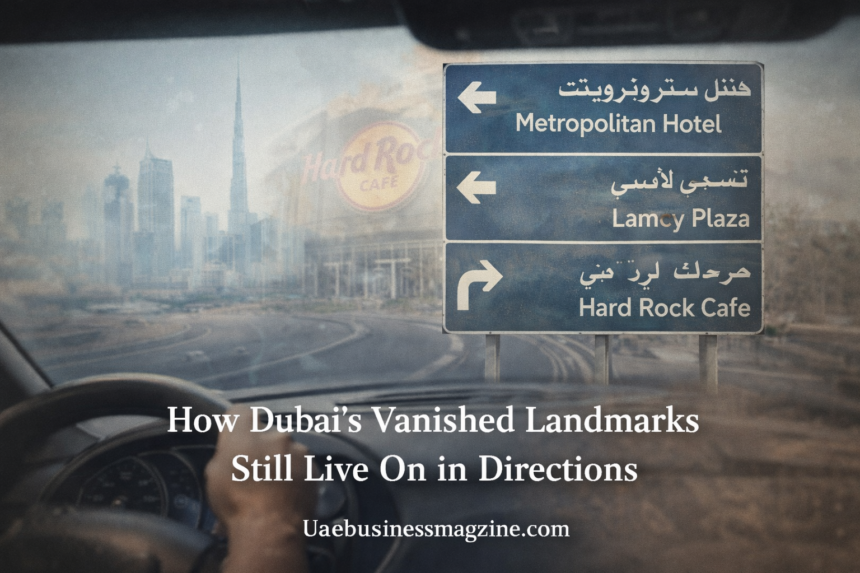
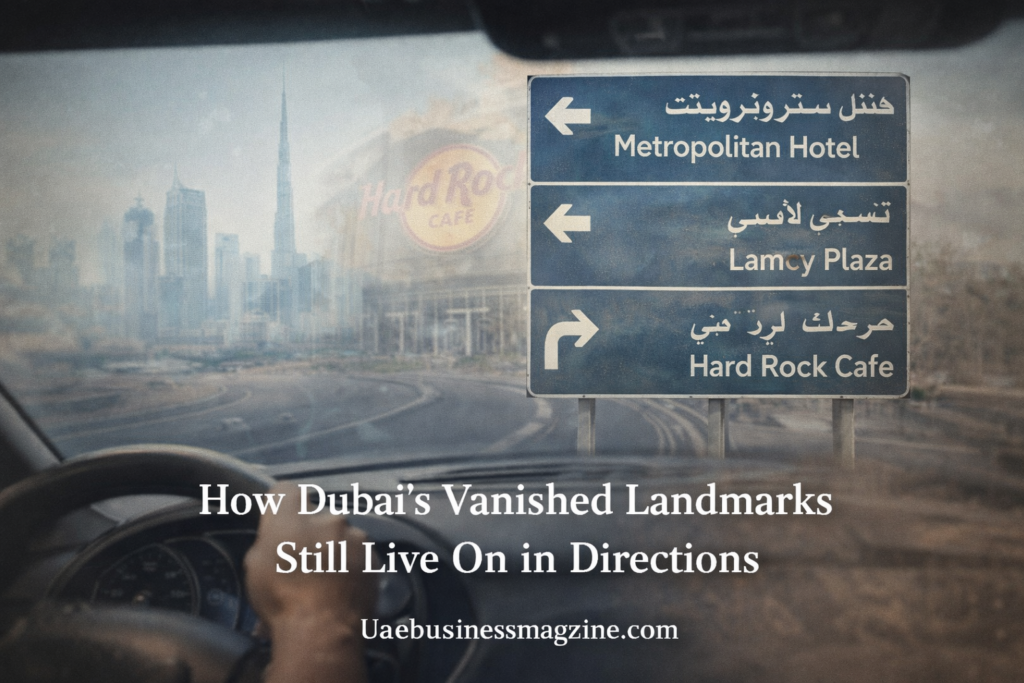
Dubai landmarks : Before GPS and digital maps, people in Dubai used famous buildings and monuments to give directions. Even though many of these Dubai landmarks have disappeared, people still use their names today when explaining where places are located!
Dubai Landmarks That No Longer Exist
Dubai has changed incredibly fast over the past 50 years. Buildings that were once famous have been torn down, roundabouts have been turned into highways, and entire neighborhoods look completely different. But something interesting happened – the names of old Dubai landmarks didn’t disappear even when the buildings did!
What are landmarks?
Simple explanation: Famous buildings, statues, or places that help people know where they are
How they work: “Turn left at the big clock” or “Go past the cinema”
Before technology: People didn’t have GPS or Google Maps
Memory helpers: Easy-to-remember places everyone knew
Still used today: Even though Dubai has modern navigation, old names survive
Let me explain how this works with some amazing examples from Dubai’s history!
Defence Roundabout: The Name That Won’t Go Away
One of the best examples is Defence Roundabout, which shows how Dubai landmark names survive even when the places completely change.
The Defence Roundabout story:
1970s name: Originally called “Defence Road”
What it was: A simple roundabout (circular road junction) on Sheikh Zayed Road
Later renamed: Officially changed to “Trade Centre Roundabout”
Current changes: Being converted from roundabout to regular intersection in 2026
Name that stuck: People STILL call it Defence Roundabout today!
Recent updates (January 2026):
The Roads and Transport Authority (RTA) is rebuilding this junction right now. Two new bridges opened in December 2025, connecting 2nd December Street, Sheikh Rashid Road, and Al Majlis Street.
But guess what? Even as workers tear down the old roundabout and build new roads, Dubai residents still say “Defence Roundabout” when giving directions!
Why the old name survived:
Everyone knew it: The name was used for decades
Easy to remember: Simple and clear
Passed down: Older residents taught newer residents
Habit: People don’t easily change how they talk
No confusion: Everyone still understands what you mean
A taxi driver who has worked in Dubai for 20 years explained: “It’s passed down from driver to driver.”
Clock Roundabout in Deira
Another famous example is Clock Roundabout in Deira, one of Dubai’s oldest neighborhoods.
About Clock Roundabout:
Location: Deira area near the old souks (markets) and Dubai Creek
What was there: A big clock tower in the middle of a roundabout
What happened: The roundabout was removed and replaced with traffic lights years ago
Still used today: Taxi drivers and residents still say “Clock Roundabout”
Why it matters: Helps people find the old souks and Creek crossings
How it’s used:
If you tell a taxi driver “take me near Clock Roundabout,” they immediately know you mean the area near Deira’s old markets, even though there’s no actual roundabout with a clock there anymore!
This Dubai landmark lives on purely as a name and memory.
Falcon Roundabout: When the Statue Flew Away
Falcon Roundabout is a funny example of how Dubai landmarks can move but their names stay behind!
The Falcon Roundabout story:
Original location: Near Garhoud area
What was there: A big statue of a falcon (UAE’s national bird) in the middle of a roundabout
What happened: The falcon sculpture was moved to a park in Mirdif
Current status: No falcon at the roundabout anymore
Name survives: People still call it Falcon Roundabout!
Another name it had:
British expat Len Chapman, who has lived in Dubai since 1971, shared a funny detail: “The Flour Mills roundabout became the Falcon or less flatteringly, the Budgie.”
“Budgie” means a small pet bird. People joked that the falcon statue looked like a budgie!
Why it was also called Flour Mills:
The roundabout sat next to big grain storage buildings (silos) that attracted thousands of pigeons. So people connected it with flour and mills!
The falcon has “flown away” to Mirdif, but the name stays at the original roundabout location.
Strand Cinema: The Theater That Disappeared
Strand Cinema was a popular movie theater in Bur Dubai that many people remember fondly.
Strand Cinema details:
Location: Bur Dubai area
What it was: A neighborhood cinema where families watched movies
Demolished: Torn down in the 1990s (over 30 years ago!)
Still referenced: People still use it in directions today
How it’s used: “Near where Strand Cinema used to be”
Why movie theaters mattered:
In the 1970s and 1980s, before streaming services and home entertainment, cinemas were major community gathering places. Everyone knew where the local cinema was located.
Even though Strand Cinema has been gone for over 30 years, older Dubai residents still mention it when giving directions, and somehow people understand what area they mean!
The Giraffe’s Neck: An Animal Landmark
This might be the most creative Dubai landmark story of all – using a giraffe’s neck to give directions!
Dr. Reza Khan, a wildlife expert who worked for Dubai Municipality until 2024, shared this amazing memory:
“At the zoo in Jumeirah, the giraffe’s long neck was visible from outside. People would say, ‘Turn left 200 metres from the giraffe’s neck.'”
How this worked:
Jumeirah Zoo: Located along Al Wasl Road
Tall giraffe: Its long neck stuck up above the zoo walls
Visible marker: You could see it from the street while driving
Perfect direction: “Turn left 200 meters from the giraffe’s neck”
Everyone understood: The giraffe was famous!
The zoo eventually closed, but for many years, this giraffe landmark helped countless people find their way around Jumeirah!
Chinese Pagoda Villa: A Navigation Point for Ships!
Emirati resident Rany Doleh shared a special family story about their unique house.
The Chinese pagoda-style villa:
Location: Along Al Wasl Road
Design: Built like a Chinese pagoda (traditional Asian tower)
So distinctive: Very different from other Dubai buildings
Used by drivers: People used it as a landmark for directions
Even ships used it: Boats offshore could see it and use it for navigation!
Imagine that – a house so unique and visible that even ships in the Arabian Gulf used it to know where they were!
This shows how important visual landmarks were in old Dubai before GPS technology.
Trade Centre: The Building You Could See from Everywhere
Dubai World Trade Centre is still standing today, but it played an even more important role in the past.
Peter Halliday, who arrived in Dubai in 1982, remembers:
“If you got lost, you always had the Trade Centre on the horizon. You could see it from tens of kilometres away.”
Why Trade Centre mattered so much:
Tallest building: For many years, it was Dubai’s tallest building
Visible everywhere: You could see it from many kilometers away
Desert surroundings: Not many other tall buildings around it
Perfect compass: Like a compass pointing you back to the city
Lost? Look for Trade Centre: If you were lost in the desert, just head toward the tall building!
Peter also remembered: “Golden Sands and Silver Sands were just two pretty buildings surrounded by sand.”
This shows how empty Dubai was in the 1980s – just a few buildings with lots of desert around them!
How People Gave Directions Before GPS
Long-time residents remember exactly how giving directions in Dubai worked before smartphones and GPS.
Josephine Finzi, a British expat, explained:
“In the days before Makani codes and satnavs, we got around by visual clues. ‘Past Spinneys on the beach road and left at the zoo’ or ‘right at the clock tower, left at the eternal flame roundabout.'”
Common direction landmarks:
Supermarkets: “Past Spinneys” or “near Choithrams”
Cinemas: “Turn left at the cinema”
Police stations: “The police station is on your right”
Schools: “Near the American School in Jumeirah”
Roundabouts: “Left at the eternal flame roundabout”
Beaches: “On the beach road”
Restaurants: “Near Picnic Home in Satwa”
These weren’t official addresses – just landmarks everyone recognized!
Sana Signal: A Clothing Store That Became a Direction
Sana Signal is a perfect modern example of how Dubai landmarks work.
The Sana Signal story:
What it was: A clothing store in Bur Dubai/Karama area
Name origin: The shop was called “Sana”
Near traffic light: Located at a traffic signal (light)
Combined name: People called it “Sana Signal”
Store closed: Shut down in 2018
Name survived: Eight years later, people still use it!
How it works today:
Ask an experienced taxi driver or older resident about “Sana Signal” and they know exactly where to go. But newer residents often get confused because there’s no shop with that name anymore!
Eternal Flame Roundabout: The Moving Monument
The Eternal Flame (also called Flame Roundabout) has an interesting history.
Eternal Flame journey:
Original location: Major roundabout on a busy road
What it was: A sculpture of a flame in the middle of the roundabout
Important landmark: People used it constantly for directions
Moved: Relocated to make way for new road construction
New home: Installed as a monument in Al Khabaisi Park
Old name persists: Some people still reference the old roundabout location
This Dubai landmark literally moved to a new location, but memories of where it used to be still help people navigate!
Who Introduced Roundabouts to Dubai?
Len Chapman, an 88-year-old British expat who arrived in Dubai in 1971, shared fascinating history:
“UK architect John Harris introduced roundabouts to Dubai in his 1959 town plan. They became the city’s punctuation marks.”
What this means:
John Harris: British architect who planned early Dubai
1959 town plan: Created Dubai’s road system design
Roundabouts: Circular road junctions British people loved
Punctuation marks: Like commas and periods in a sentence, roundabouts divided the city into sections
Dubai’s structure: Roundabouts organized how Dubai grew
These roundabouts became so important that even when they disappeared, their names remained as navigation landmarks!
Why Do Old Names Survive in Dubai?
Several reasons explain why Dubai landmark names don’t disappear even when the landmarks do.
Reasons old names survive:
Habit and memory: People don’t change how they talk easily
Teaching new people: Older residents teach newcomers the old names
Community knowledge: Shared understanding among long-time residents
Simpler than new names: “Defence Roundabout” is easier than “The intersection of Sheikh Zayed Road and 2nd December Street”
Emotional connection: People have memories attached to old names
Practical use: The old names still work – everyone understands them
Missing official names: Some places never got good official names
Mohammad Kazim, an Emirati cultural consultant, explained:
“People came and went all the time. So landmarks mattered. They were how you explained the city to someone who didn’t know it yet.”
Modern Dubai vs Old Dubai Directions
Let’s compare how giving directions works in Dubai now versus before.
Old Dubai (before GPS):
- “Turn right at Clock Roundabout”
- “Left at the giraffe’s neck”
- “Past Strand Cinema”
- “Near Defence Roundabout”
- “At the Eternal Flame”
- Based on visual landmarks everyone knew
- Required local knowledge
- Passed down person to person
Modern Dubai (with technology):
- GPS coordinates
- Makani codes (Dubai’s digital addressing system)
- Google Maps directions
- Street names and building numbers
- “Navigate to this location” button
- Works for anyone with a smartphone
- No local knowledge needed
But here’s what’s interesting: Even with all this technology, many Dubai residents still use the old landmark names because they’re easier and more familiar!
What Are Makani Codes?
You might be wondering: What are these “Makani codes” people keep mentioning?
Makani system explained:
What it is: Dubai’s official digital addressing system
How it works: Every building gets a unique 10-digit number
Purpose: Makes finding addresses easier and more precise
Example: Instead of “the building near the roundabout,” you say “Makani code 1234567890”
Introduced: Relatively recently to modernize Dubai’s addressing
Problem it solved: Dubai grew so fast that traditional addressing couldn’t keep up
But even with Makani codes, people still prefer saying “near Defence Roundabout” because it’s what they’re used to!
How Dubai Changed So Fast
To understand why Dubai landmarks disappear, you need to know how incredibly fast Dubai developed.
Dubai’s amazing transformation:
1970s: Mostly desert with a few buildings
1980s: Growing city with some high-rises
1990s: Rapid expansion and development
2000s: Became a global city with famous skyscrapers
2010s: Continued massive growth
2020s: One of world’s most modern cities
What this meant:
Constant construction: Buildings torn down and rebuilt
Roads redesigned: Roundabouts became highways
Neighborhoods transformed: Empty desert became urban areas
Old landmarks removed: Made way for bigger, newer structures
City unrecognizable: Someone from 1970s wouldn’t recognize 2026 Dubai
Peter Halliday described this: “If you went past Galadari Roundabout and saw Al Mulla Plaza, you knew you were heading towards the border post and the wilds of Sharjah.”
Today, that same route is completely developed with buildings everywhere – no “wilds” at all!
The Role of Facebook Groups in Preserving Memories
Interestingly, social media helps keep memories of old Dubai landmarks alive.
Dubai – The Good Old Days:
Platform: Facebook group
Purpose: Share old photographs of Dubai
Content: Pictures of demolished buildings, old streets, vintage scenes
Discussions: People debate timelines and share memories
Community: Connects people who remember old Dubai
Personal context: Adds stories to the city’s changing landscape
These online communities ensure that even when Dubai landmarks physically disappear, their memories and photographs survive digitally for future generations!
Why This Matters for Dubai’s Identity
The survival of old landmark names is actually quite important for Dubai’s culture and identity.
Cultural significance:
Collective memory: Shared names create community bonds
Historical continuity: Connects past and present Dubai
Cultural identity: Reminds people of Dubai’s roots
Storytelling: Old names carry stories worth preserving
Sense of place: Helps people feel connected to location
Generational bridge: Links older and younger residents
Emirati heritage: Important for local Emirati culture
In a city that changes as fast as Dubai, these persistent landmark names provide a sense of continuity and history that physical buildings can’t offer.
Will Today’s Landmarks Survive Tomorrow?
An interesting question: Will buildings that are famous in Dubai today still be referenced 50 years from now?
Landmarks that might survive as names:
Burj Khalifa: Dubai’s tallest building – likely to be referenced forever
Dubai Mall: Massive shopping center everyone knows
Palm Jumeirah: Unique palm-shaped island
Burj Al Arab: Iconic sail-shaped hotel
Dubai Marina: Entire neighborhood name
Potential for disappearance:
However, if history teaches us anything, some of today’s most famous Dubai landmarks might be demolished in future decades and only survive as direction names, just like Defence Roundabout and Strand Cinema!
Lessons from Dubai’s Vanishing Landmarks
What can we learn from how Dubai landmarks disappear but their names survive?
Important lessons:
Change is constant: Cities always change and evolve
Memory is powerful: People’s memories outlast physical structures
Language preserves history: The words we use carry the past forward
Community matters: Shared references create community bonds
Technology doesn’t replace everything: GPS can’t replace human memory
Culture adapts: People find ways to preserve what matters to them
Value the present: Today’s normal might be tomorrow’s nostalgia
Conclusion: Dubai’s Invisible Map
Dubai has two maps running at the same time. One map shows the actual roads, buildings, and structures you can see and touch today. The other map exists only in people’s minds and conversations – a map of vanished Dubai landmarks that no longer physically exist but continue living through the names people use.
Key takeaways:
- Defence Roundabout: Still called that despite being renamed and rebuilt
- Clock Roundabout: People use the name even though the clock is gone
- Falcon Roundabout: The statue moved but the name stayed
- Strand Cinema: Demolished in 1990s but still referenced today
- Giraffe’s neck: Creative direction using zoo animals
- Before GPS: People relied entirely on visual landmarks
- Names survive: Old landmark names outlast the actual landmarks
- Community memory: Passed down from person to person
- Dubai’s speed: City changed incredibly fast
- Cultural importance: Old names preserve Dubai’s history
Next time you hear someone in Dubai say “near Defence Roundabout” or “at Clock Roundabout,” remember – you’re hearing echoes of a Dubai that no longer exists physically but lives on through the words people use every single day!
These invisible landmarks prove that you can tear down buildings, remove statues, and completely redesign roads – but you can’t easily erase the names from people’s memories and conversations. That’s the power of community memory in Dubai!
Reference By : khaleejtimes.com
Read More : Uaebusinessmagazine.com

